Find the fog window.
Log collection and weather across seasons. Exposure, wind direction and the timing of dry periods shape whether a site deserves a pilot.
Fog water for agriculture begins with a real resource, a useful collector and a route to storage. FogFarm connects all three.
FIELD-WATER PROGRAM / PLANNING · NO PILOT SITE SELECTED
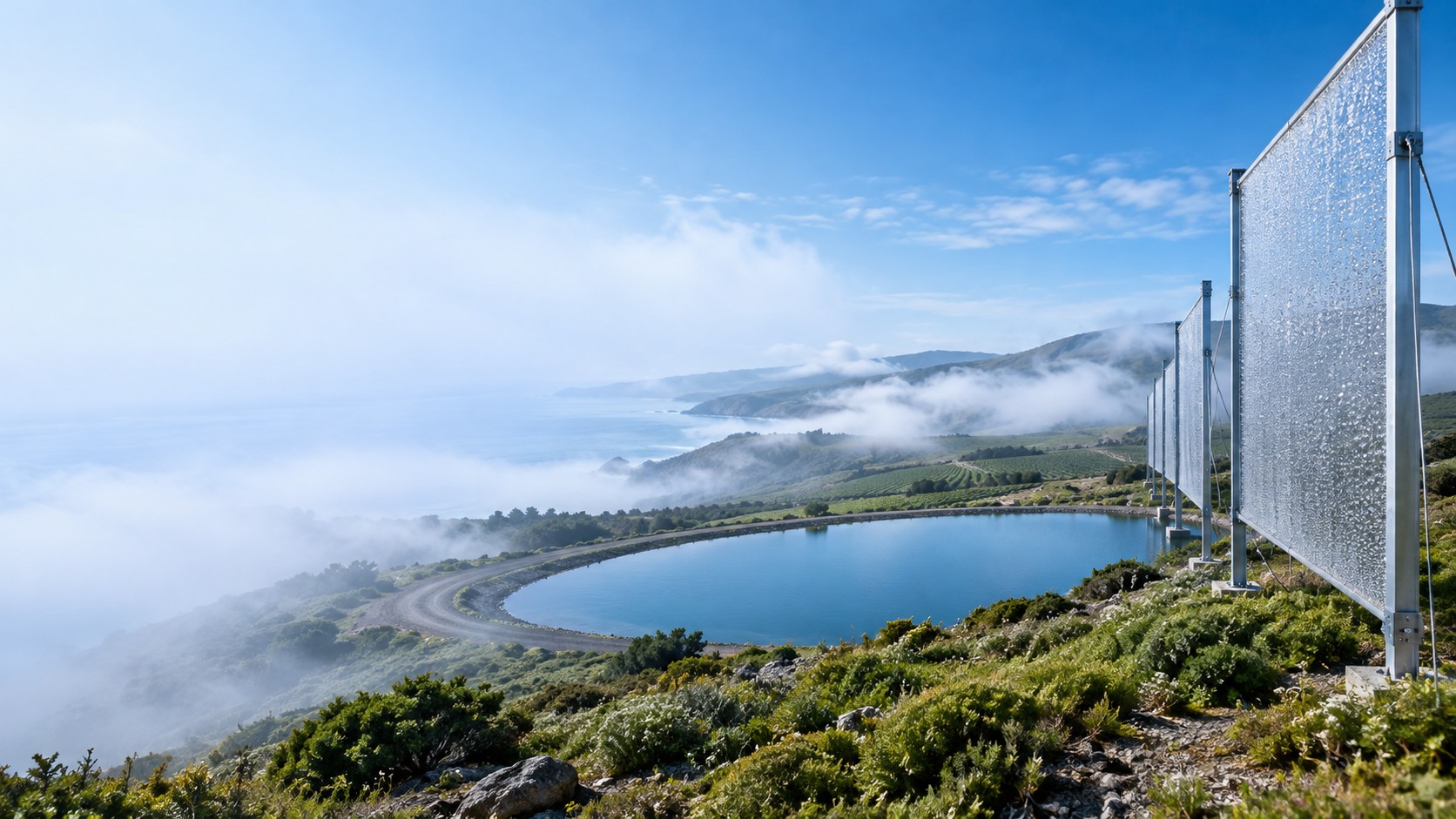
A collector’s catch becomes useful only when it reaches storage at the right time, with suitable quality and an acceptable operating cost.
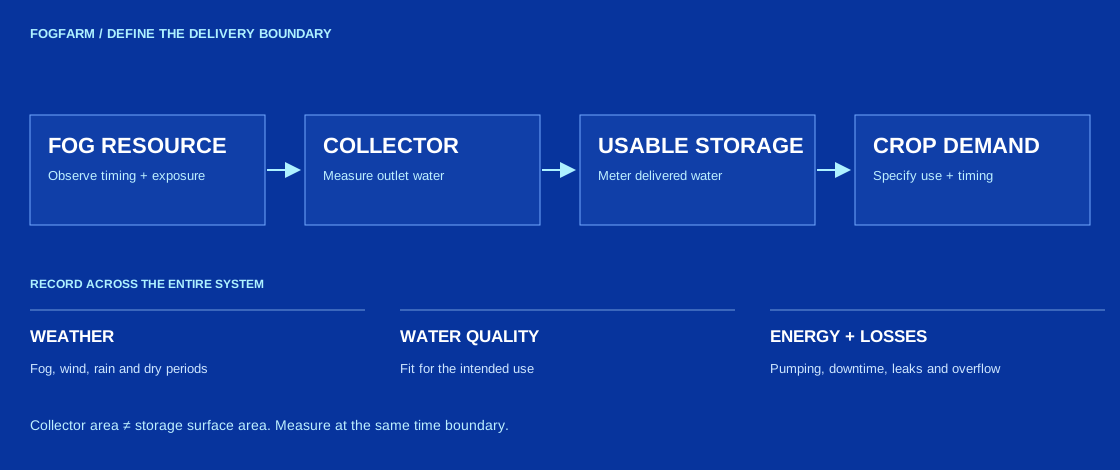
Log collection and weather across seasons. Exposure, wind direction and the timing of dry periods shape whether a site deserves a pilot.
Measure a competent passive collector first. Record drainage losses, downtime and water at the tank before considering an active enhancement.
Compare delivered water with the intended crop schedule. Include storage, pumping, treatment and maintenance in the proposed supply system.
Selected primary research, with the connection to this program made explicit. These are results from the named authors, not Weatherhill trials.
Measurements at two Atacama sites were combined with greenhouse and crop-demand modeling. The paper connects collected water to a specific agricultural use.
What collector area and storage would cover a selected crop’s dry-period demand at our eventual site?
Standard collectors and a spatial model were used to assess fog-water opportunities around Alto Hospicio, Chile.
Where do measured yield, access and demand justify a practical pilot rather than a regional extrapolation?
Li and colleagues studied how folded collector geometry affects airflow, droplet deposition and water drainage.
Which passive design remains effective under natural wind, fouling and maintenance constraints?
Zhang and colleagues combined a fog collector with droplet-driven nutrient production and crop experiments. Their large-scale agricultural implications are projections.
Which added functions are useful enough to justify their complexity after basic water delivery is established?
Published figures from independent research. Open any image at full size, then follow its source.
 ENLARGE ↗
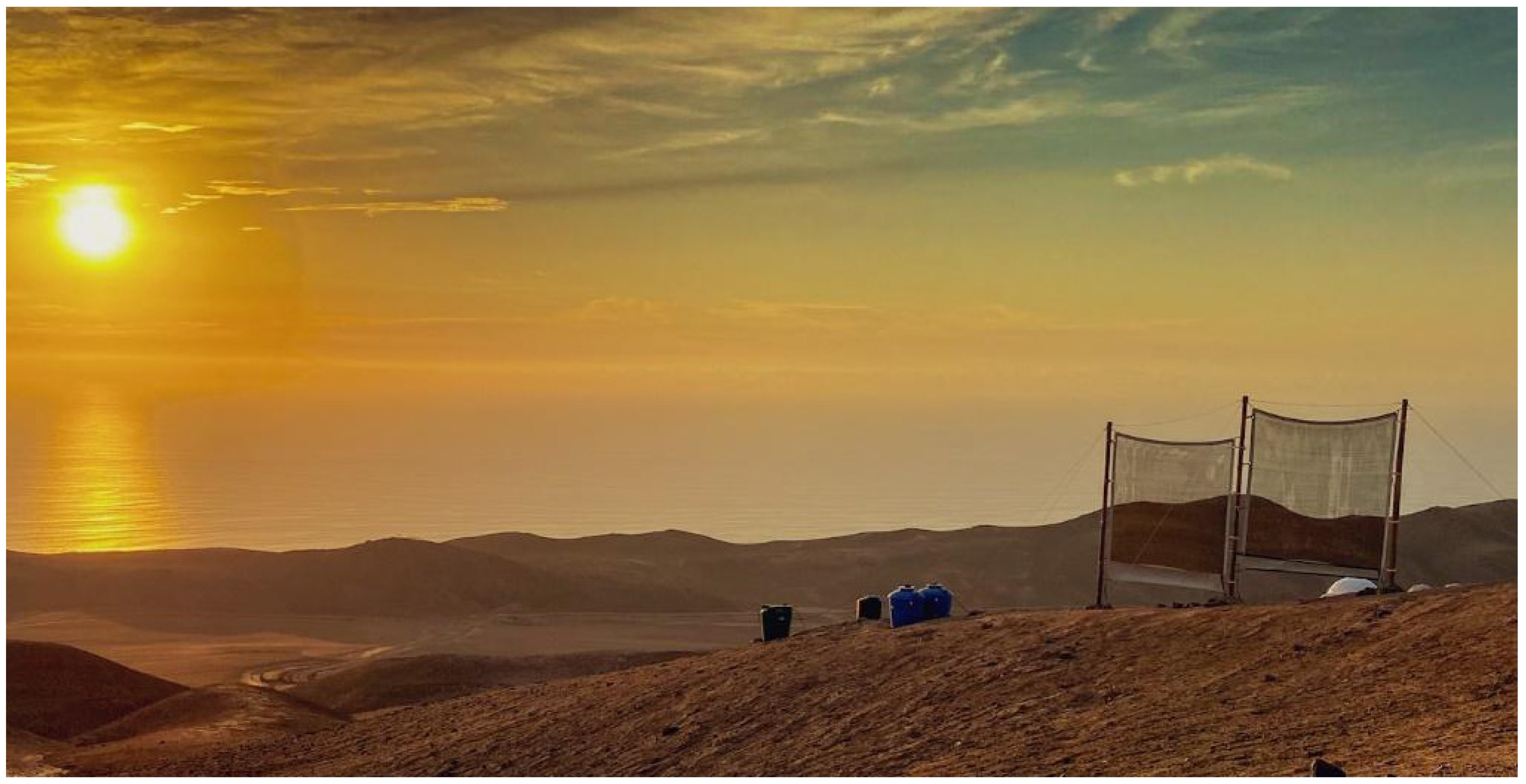
Large passive fog collector at the Atacama UC Experimental Station, Alto Patache, Chile. This is a published research site, not a Weatherhill installation.
Albornoz, del Río, Carter, Escobar & Vásquez · 2023 · Sustainability, Fig. 1. Original paper ↗ · CC BY 4.0. Figure reproduced without content changes; web display resized.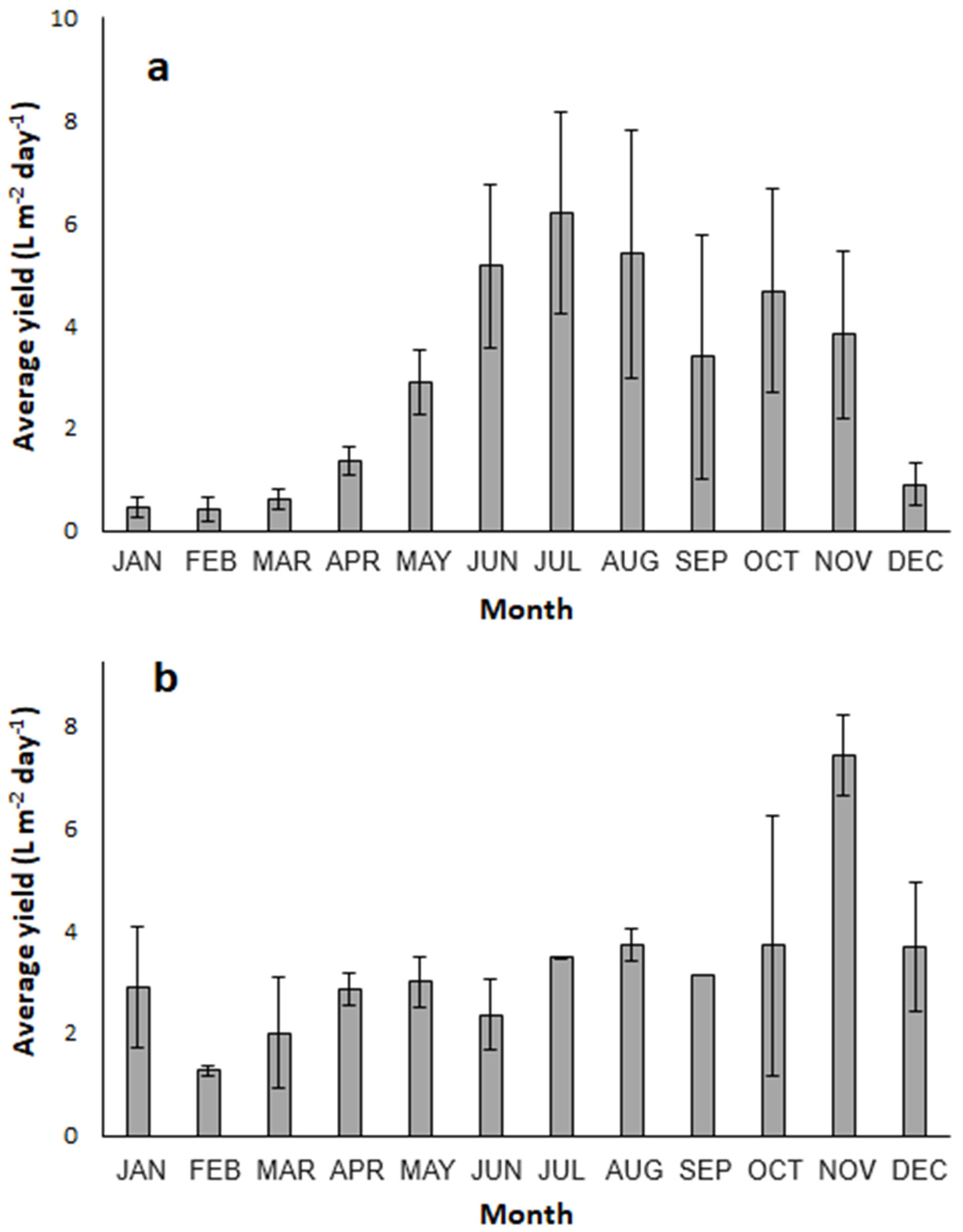 ENLARGE ↗
Monthly average daily collection, with standard errors, at Alto Patache and Falda Verde. Collector area is the denominator; these are site-specific observations.
Albornoz, del Río, Carter, Escobar & Vásquez · 2023 · Sustainability, Fig. 4. Original paper ↗ · CC BY 4.0. Figure reproduced without content changes; web display resized.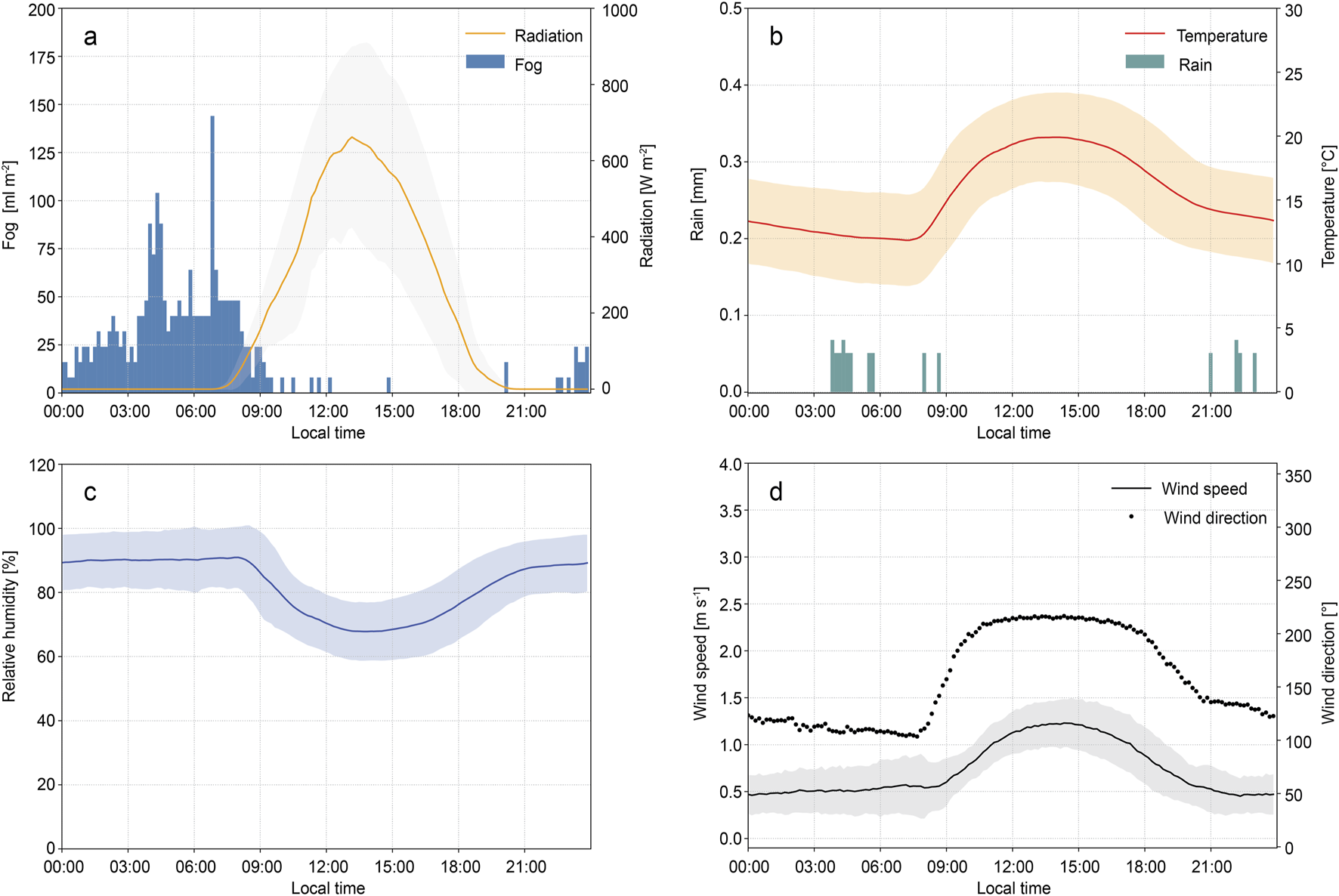 ENLARGE ↗
Published diurnal profiles of fog collection and weather at Alto Hospicio. Timing matters when matching collection, storage and demand.
Carter, Verbrugghe, Lobos-Roco, del Río, Albornoz & Khan · 2025 · Frontiers in Environmental Science, Fig. 7. Original paper ↗ · CC BY 4.0. Figure reproduced without content changes; web display resized.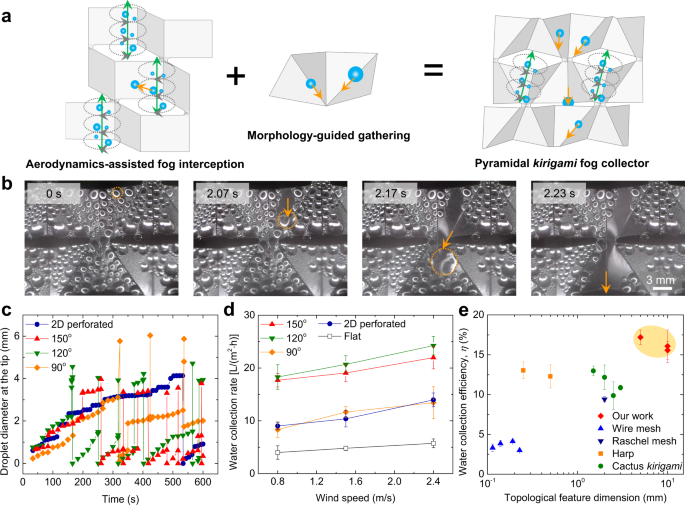 ENLARGE ↗
Published experiments on droplet drainage from pyramidal kirigami collectors. A collecting surface and its drainage route act as one system.
Li, Ran, Wang, Wang, Chen, Niu, Arratia & Yang · 2021 · Nature Communications, Fig. 3. Original paper ↗ · CC BY 4.0. Figure reproduced without content changes; web display resized.Explore collection area, delivery losses and demand. Replace the illustrative inputs with measurements from the candidate site.
A first-pass daily water balance. The collection input is water measured at the collector outlet per square metre of projected collecting area.
Enable JavaScript to calculate this scenario.
Constant daily inputs do not model seasonality or reliability. Storage is a demand-only buffer, assumes it is filled beforehand, and excludes reserve volume, tank evaporation and leaks.
Delivered = yield × area × delivery fraction. Demand coverage = delivered / demand. Required area = demand / (yield × delivery fraction). Dry-period buffer = daily demand × dry days. Apply delivery losses only after the collector outlet; do not count capture efficiency twice.
Compare complete energy use with water delivered.
Engineering / OPEN TOOL ↗Explore area, air speed and pressure-work costs.
Atmosphere / OPEN TOOL ↗Relate air temperature and humidity; this does not predict fog yield.
Experiments / OPEN TOOL ↗Build a measurement budget for a small field-water signal.
The complete tools include methods, assumptions and export controls. Open all 15 tools →
A staged program: measurements, comparisons and a decision before the next scale.
Install calibrated reference collection and weather measurements. Separate fog collection from rainfall, dew and missing records.
Advance when: the data cover the relevant seasonal and demand windows.Compare geometry and material with matched exposure, drainage and maintenance logs. Keep the denominator and collector orientation explicit.
Advance when: delivered-water differences survive exposure and uncertainty checks.Meter inlet, outlet, overflow and tank losses. Sample water for the intended crop and irrigation system. Record labor, replacement and pumping energy.
Advance when: the measured supply and water quality address a defined use.Only after the baseline, compare powered operation against the identical unpowered assembly with measured auxiliary costs.
Advance when: incremental useful water supports the next pilot decision.CSV templates contain headers and units only. No measurements or results are prefilled.
Every paper below opens at its DOI. The figures above carry their own source and reuse license.
Research selection checked 13 October 2026. Program connections are Weatherhill’s proposed applications of the literature.
Instrument development, field water and controlled deposition share a measurement foundation.
Google Analytics helps us understand which pages are useful. Without analytics cookies, Google still receives limited cookieless measurements and consent signals. Cookies are used only if you allow them. Every tool and paper is available either way. Privacy details