Establish the baseline
Match weather events to site records and identify who actually incurs the cost.

Fog. Hail. Lightning. Wind. Research and pilot planning for the weather that constrains an airfield—and the evidence needed to do something useful about it.
Design partners sought · Research stageAI-GENERATED CONCEPT ART · NO DEPLOYMENT SHOWN
An airport does not need another promise to control the sky. It needs to know which constraint can change, who benefits, and what the evidence will have to show.
Weatherhill is developing an airport weather program around site assessment, measurement and local fog-mitigation research. Our first proposed commercial engagement is an Airport Weather Readiness Study. The next step is a defined pilot with a clear decision at the end.
Design partners sought. No Weatherhill airport deployment, certified aviation system or measured reduction in delays is represented.
Find the technical evidence, practical questions and next step for the weather problem you actually face.
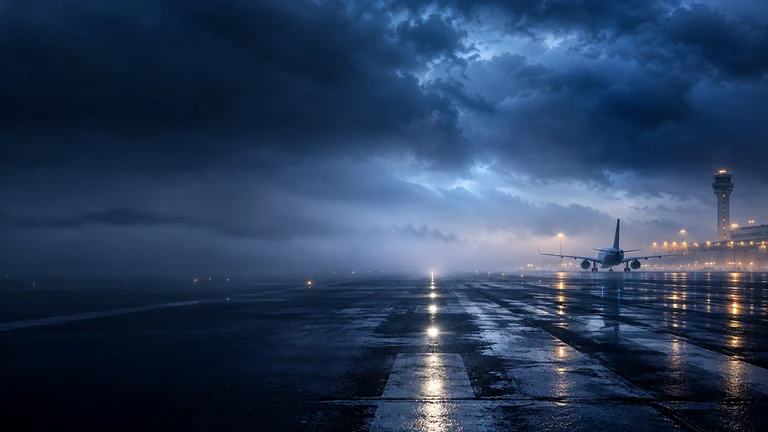
What would it take to reduce fog where an airport actually needs visibility? We are developing a measured path from local fog physics to a credible airport pilot.
Explore airport fog mitigation ↗Runway visual range, meteorological optical range and a photograph describe different things. An airport visibility project needs to measure the right outcome before it can claim an improvement.
Explore runway visibility ↗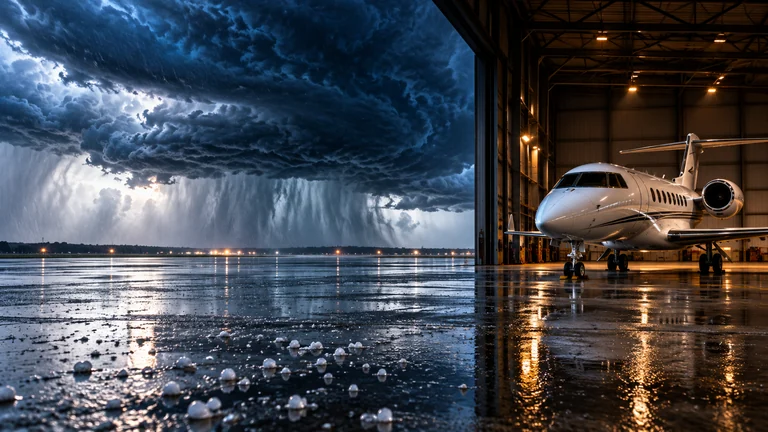
An airport hail program starts with exposed aircraft, available shelter and the time required to act. Weatherhill is developing a practical assessment of those constraints and the investments that could address them.
Explore airport hail protection ↗Lightning decisions connect weather information, people, equipment and recovery. Our proposed airport assessment examines that entire chain so investment priorities reflect how the ramp actually operates.
Explore lightning and ramp readiness ↗Airport wind resilience starts with coverage, local exposure and operational context. Weatherhill is developing a study that connects existing observations to practical decisions and a defensible investment plan.
Explore wind and windshear ↗Heavy rain links runway conditions, drainage, facilities and ground operations. Our proposed airport study identifies where evidence is missing and which improvements deserve engineering or operational review.
Explore heavy rain and drainage ↗Electrostatic collection offers a physical mechanism for capturing droplets. The airport question is harder: does an intervention produce a sustained, spatially useful visibility improvement as fresh fog moves in?

Concept artwork. Research instruments are not represented as installed hardware.
Match weather events to site records and identify who actually incurs the cost.
Review current observations, procedures, shelter and infrastructure with the operator.
Compare established options and an appropriate research path against the same outcome.
Deliver a scope, measures, budget assumptions and go/no-go criteria.
What the proposed $30 billion airport modernization bill means for weather resilience—and how to distinguish a funding route from an award.
Explore airport weather funding ↗Published research shows that electrical forces can improve fog collection. Weatherhill is investigating the next question: whether that mechanism can produce a useful visibility effect for an airport application.
Explore electrostatic fog collection ↗Our airport program separates published science, proposed work and demonstrated results. This is the evaluation standard we intend to use when deciding which ideas deserve another experiment—and which do not.
Explore evidence and evaluation ↗Airport operators, airlines, FBOs, engineering teams and research partners: help define a measurable first project.
Google Analytics helps us understand which pages are useful. Without analytics cookies, Google still receives limited cookieless measurements and consent signals. Cookies are used only if you allow them. Every tool and paper is available either way. Privacy details